
Glaucoma

Glaucoma: Buckling Under Pressure. Half of all glaucoma patients do not know that they have the disease. Most do not have any symptoms until a significant portion of their vision is irreversibly lost. Glaucoma can affect just about anyone, but there are ways to protect yourself.
What is Glaucoma?
Glaucoma damages the optic nerve which carries visual information from the eye to the brain. We still do not know what causes glaucoma. The damage often starts in the periphery of the visual field and gradually works its way toward the center. Intraocular pressure (IOP) is thought to be a very important factor. Lowering the IOP will slow or even stop the progression. Many patients will develop glaucoma even if their IOPs are within the normal range, while others with high IOPs do not develop glaucoma. Until more is known, glaucoma should be thought of as a degenerative disease of the optic nerve with potentially many causes. It is important for patients with glaucoma to work closely with their eye doctors and primary care physicians to mitigate problems that may be associated with glaucoma.
The eye continuously synthesizes a fluid called the aqueous humor. It circulates through the various chambers of the eye before draining out of the eye through a special filter. Normally there is a delicate balance between the production and drainage of the aqueous humor. Many patients with glaucoma have decreased drainage leading to a build up of fluid and an increase in IOP. There are many different types of glaucoma, each having a different mechanism through which pressure inside the eye is increased. The treatments are different, but generally involve lowering the pressure in some way.
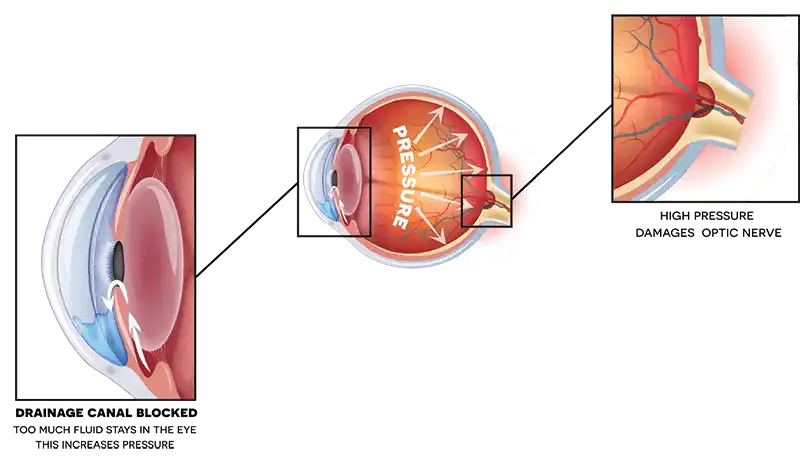
Who Gets Glaucoma?
- High eye pressure.
- Race: African Americans are more prone to chronic open angle glaucoma, the most common type of glaucoma. Asians have a higher incidence of narrow angle glaucoma.
- Age: glaucoma is more common in the elderly.
- Family history of glaucoma: patients with blood relatives with glaucoma have a much higher risk.
- Injury: direct, high-impact trauma to the eye may cause glaucoma months or even years later.
- Near-sightedness (myopia): near-sighted patients are more likely to get chronic open angle glaucoma, while far-sighted patients are more prone to get the less common narrow angle glaucoma.
- Respiratory diseases, sleep apnea, and several other diseases have been linked to glaucoma.
Some glaucoma patients have none of these risk factors. Because glaucoma usually does not cause symptoms initially, it goes undetected until very late. Therefore, patients should get periodic eye exams, and those with risk factors should be checked more frequently.
Treatment For Glaucoma
Depending on the type and severity of glaucoma, various treatments are available. Most patients will be treated initially with eye drops to lower the intraocular pressure. However, if the disease progresses, further interventions are necessary.
SLT - Selective Laser Trabeculoplasty
SLT is a laser procedure to treat open angle glaucoma. In most cases, SLT is as effective as an eye drop in lowering the intraocular pressure. SLT is a great option for patients who cannot take eye drops due to allergies or sensitivities and for patients who would otherwise have to be on multiple medications. SLT may also be a good initial treatment.
LPI - Laser Peripheral Iridotomy
LPI uses a laser to create a small hole in the iris. This is a common treatment for narrow angle glaucoma, in which the intraocular pressure is high due to the drainage angle being physically blocked. Creating a hole in the iris allows the fluid in the eye to drain more easily and effectively.
i-Stent - Minimally Invasive Glaucoma Surgery (MIGS)
The i-Stent is a drainage device implanted within the eye to allow fluid to drain more effectively. This procedure is done in conjunction with cataract surgery. It works great for patients with mild to moderate glaucoma and who also need to have cataracts removed. It will reduce the treatment burden of using eye drops and is less invasive than traditional glaucoma surgery.
Trabeculectomy
Trabeculectomy is a common procedure for advanced glaucoma. With this surgical intervention, a portion of the drainage angle is removed and fluid from inside the eye is more easily drained externally.

Micropulse
This laser procedure offers a highly effective and safe treatment for patients with glaucoma who need lower eye pressure and have not responded to or are not good candidates for topical eye drops or selective laser trabeculoplasty. It works by providing short bursts of laser energy to the ciliary body (the structure inside the eye that produces aqueous fluid and is in part responsible for elevated eye pressure). Inflammation occurs with this process and most patients are prescribed topical anti-inflammatory drops afterwards to allow for proper healing. Most patients experience an improvement in eye pressure immediately after the procedure, and the laser can be repeated if adequate eye pressure is not achieved after the first treatment.
For additional information on glaucoma you can visit the eye health information website EyeSmart from the American Academy of Ophthalmology.
Have questions about glaucoma?
Our experienced team is ready to help you see clearly.
Schedule a Consultation