
Macular Degeneration

Macular Degeneration: A Tough Nut to Crack. Macular degeneration is the most common cause of legal blindness (less than 20/200 in both eyes) among people over age 60 in the United States, afflicting millions.
Understanding the Macula
The macula is located in the middle of the retina. The center of the macula is the fovea, which controls central vision, the sharpest portion of the entire visual field.
We use the macula and fovea for reading, cooking, watching TV, playing tennis, distinguishing colors, and just about everything that requires perception of fine details.
Macular degeneration destroys the most important part of the retina. Macular degeneration generally does not affect peripheral vision, so patients do not go completely blind.
Macular degeneration is a diverse group of diseases, the most common of which is age-related macular degeneration (ARMD or AMD).

What Causes Macular Degeneration?
AMD is classified into the "dry" and "wet" forms. The much more common dry form is characterized by degeneration of the macula and tissues that support the function of the macula. As these tissues die, vision loss progresses and generally cannot be reversed. There are ways to mitigate the risk and slow the progression of disease. Fortunately, not everyone will suffer from significant vision loss, and vision loss tends to progress relatively slowly, over the course of many years.
Occasionally, dry macular degeneration transforms into the more serious wet form: abnormal blood vessels, proliferate under the macula, causing bleeding, swelling, and eventually scarring. Vision may deteriorate rapidly and suddenly from wet AMD. Depending on the location of the macular degeneration (whether it is directly under the very center of the macula) and the stage of the disease, different treatments may improve or stabilize vision.
Risk Factors
- Age. The risk of AMD rises steadily with age.
- Caucasian race, especially those with blue eyes.
- Smoking. Smokers have much higher risk of developing AMD and suffering vision loss from AMD.
- Diet high in fat and cholesterol.
- High blood pressure.
- Genetics. The genetics appears very complicated. Although the risk of blood relatives of an AMD patient is higher than that of the general public, the risk cannot be easily quantified.
Symptoms
- Central vision loss
- Distorted vision - straight lines appear wavy
- Shady or blurry areas near the center of vision
- Sudden onset of symptoms is possible
- Often affects one eye initially
- Mild cases may be asymptomatic

How Do You Diagnose Macular Degeneration?
Macular degeneration is diagnosed by examining the retina. The patient may be completely asymptomatic at the earlier stages of the disease. Frequently, ancillary testing such as optical coherence tomography (using light to scan the macula to obtain a high definition, cross-sectional picture) or fundus photography (a magnified color photograph of the macula) is taken in the office non-invasively to document the stage and severity of the disease.
How Does Macular Degeneration Get Treated?
There is currently no effective conventional remedy for dry macular degeneration that can reverse vision loss. However, various nutritional supplements may reduce its rate of progression. Additionally, recent studies showed that photobiomodulation (PBM, using certain light frequencies to treat the retina) may slow the disease. Injections of certain medications into the eye can reduce the progression of the most severe form of dry macular degeneration, called geographic atrophy.
The current standard of care for wet macular degeneration is an injection of medication into the eye. While not without discomfort, the injections are well-tolerated by most patients. Many clinical trials have confirmed the benefits of intraocular injections of certain medications in treating active wet macular degeneration. However, they do not benefit every patient and often require ongoing treatment every few weeks to months, usually for many years. Treatment regimens are often highly individualized, so discuss with your eye doctor about your specific situation.
Prevention and Stabilizing Macular Degeneration
Because we don't know exactly what causes AMD, there is no sure way to prevent the disease. However, you can improve the odds by:
- Quitting smoking.
- Controlling high blood pressure by exercise, diet, and medications.
- Avoiding excessive ultraviolet light (stay out of the sun or wear glasses with UV light protective coating).
- Consuming a healthy diet rich in fruits, vegetables, and dietary fiber. Restriction of animal fat and cholesterol may be helpful.
- Taking lutein, zeaxanthine, and/or the AREDS (Age-Related Eye Disease Study) formulas. Seek advice of your eye doctor and medical doctor before initiating these supplements, especially if you smoke or have a history of smoking.
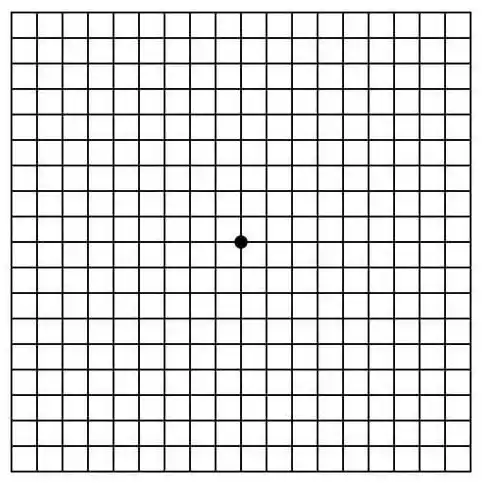
Once you have been diagnosed with macular degeneration, you should perform periodic Amsler grid exam:
- Hold the grid 14 inches away; put on reading glasses.
- Cover one eye.
- Focus on the black dot in the center of the grid.
- If any areas on the grid are hazy, black, distorted, or discolored, or if any lines are crooked, or if the exam appears to have changed since the last time, notify your doctor.
- Repeat with the other eye.
Have questions about macular degeneration?
Our experienced team is ready to help you see clearly.
Schedule a Consultation